
entrust: Supporting Ireland’s infrastructure journey, from planning to consent
20th July 2026
ESB: Delivering today, for future us
20th July 2026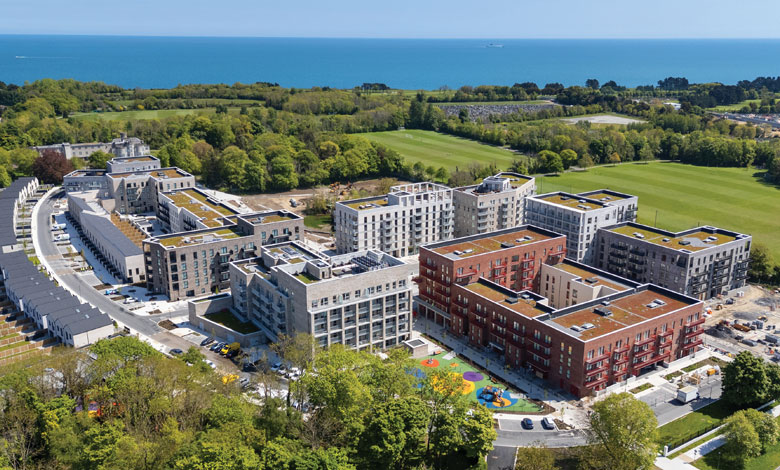
The Land Development Agency (LDA) is the State’s affordable housing delivery body. Its main role is to acquire and develop state and other land to deliver affordable homes to address the country’s housing need. This is particularly important in the context of Government’s Delivering Homes, Building Communities plan requirement for a step change to achieve delivery of up to 60,000 homes per annum by 2030.
A significant amount of activity is underway across the Local Authority sector to zone additional lands through Development Plan Variations to increase the pipeline and support in achieving housing targets. The Land Development Agency (LDA) is working in partnership with the Local Authorities and others to support in building the pipeline and delivering more affordable homes.
The LDA has construction underway on 20 sites; both state sourced and privately acquired land. It has a strong delivery pipeline of more than 25,000 homes through its direct delivery and homebuilder partnership channels. Additionally, the LDA undertakes work on large-scale longer-term strategic areas by master-planning and bringing forward planning applications in locations such as Cork Docklands and the Digital Hub in Dublin.
The LDA is also responsible for a range of public functions including research, master planning and the development of its own design guidelines and good practice for sustainable development and placemaking.
Public lands analysis and reporting
Historically, data analysis has proved challenging in the planning sector due to fragmented or out of date or inconsistent datasets coupled with limited interoperability.
Progress is however being achieved, with technological advancement, and work across the sector using a data-led GIS approach to support spatial planning capability.
In support of our mandate, the LDA has developed a detailed understanding of state lands alongside high-quality geospatial datasets, creating a shared platform and evidence base using open source and stakeholder data.
The LDA has developed GIS tools and spatial analysis to support the land assessment process. This also supports an important forward-planning dimension to achieve an integrated and spatial approach to assessing housing, infrastructure and climate related aspects.
The Land Development Agency Act 2021 requires the LDA to produce a Register of Relevant Lands and a Report on Relevant Public Land. Both tools facilitate the identification and assessment of the potential of relevant public land to provide affordable housing both now and in the future.
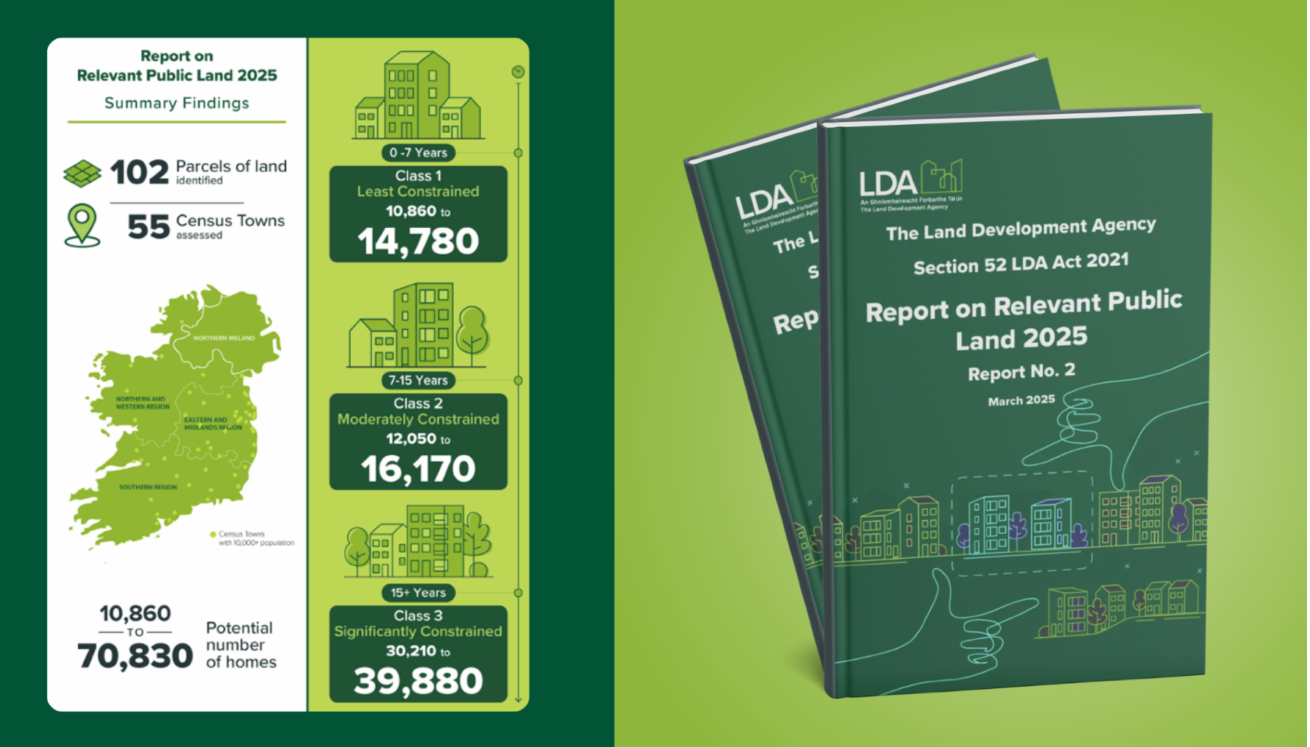
The LDA’s Report on Relevant Public Land published in 2025 identified 102 state owned sites with the potential for 70,830 homes on publicly owned land across Ireland in 55 locations, cities, towns and urban areas with a population greater than 10,000 people.
The Report findings noted that, of the land identified, less that 20% has low levels of constraints. This means that of the total lands identified, there is limited land that has potential for near term delivery for some 10,830 homes and a number of these are now being progressed. Findings also cautioned that 80% of the lands identified are either moderately or significantly constrained with many in active operation for non-housing uses by their current owners. Unlocking complex regeneration sites is expected to require investment in infrastructure and or relocating existing services or businesses. In some cases, the costs for unlocking certain sites may not make economic sense. However, several well-located strategic regeneration sites have potential to deliver wider public and placemaking benefits over time. The LDA has undertaken socio economic analysis which supports in making a case for public investment to enable and unlock their potential.
This information and analysis support a greater understanding of the capacity and potential of lands in terms of policy choices and decision-making for development into the future.
The LDA is currently undertaking assessment in preparation for its next Report on Public Lands.

PropTech Award 2025 winner LDA on stage.
Spatial planning and placemaking
At its core, the LDA’s mandate, is to assemble, manage, and develop relevant public land which requires a strong understanding of place. This is where mapping and GIS are not only important technical tools; they are also necessary for supporting spatial analysis and policy delivery.
The LDA has developed GI led tools using our data to add a spatial dimension to public lands. The LDA GIS Team can align this data with key transport infrastructure, employment centres and social and utility infrastructure. This allows for the identification of the public lands with the least constraints and the highest attributes for housing development.
This supports identification and analysis of key areas with potential for future sustainable development which supports a forward-planning dimension and early-stage analysis for sustainable land use optimisation and activation.
Use of GIS and spatial planning also supports in shaping future urbanism, including scenario modelling, and real-time data integration to test development options. The LDA is well placed to work with our partners to support evidence-based decision-making that balances housing delivery with long-term sustainability outcomes. The use of spatial planning and GIS tools can support and enhance transparency and enable clearer communication with stakeholders and communities.
Open data
All of the LDA’s data on public lands is available in free and open formats and can be downloaded from data.gov.ie. The LDA has six datasets on public lands and can be used to develop new maps, dashboards, spreadsheets, etc. This data has been shared and used by LDA’s partners, including local authorities, relevant public bodies, and research bodies.
The LDA has a focus on updating data and continually developing our mapping capabilities with fresh planning data and optimising our GIS tools to support our mandate and improve the accuracy and availability of up-to-date information. These tools are made possible with collaboration and data sharing with key stakeholders in the planning community. The ongoing success of data-driven spatial planning depends on continued development of the tools and datasets through collaboration.
Looking forward, the LDA will continue to develop the GIS tools and spatial data platform to support shared objectives around planning for sustainable development. This supports in building sectoral capacity and capability and an integrated approach for strategic and spatial understanding of place.
Dearbhla Lawson
Director of Planning Services
The Land Development Agency
George’s Court, 54-62 Townsend Street Dublin, D02 R156
T: +353 1 910 3400
W: www.lda.ie


 Ossian Smyth TD
 Florika Fink-Hooijer
 Antoine Oger
 Laura Curtis-Moss
 Anthony Costello
 Niall Ó Donnchú
 Mike Savage
 Brian Carroll
 Oisín Coghlan
 Stephen Onakuse
 Kevin O’Sullivan
 Hendrik W van der Kamp
 Philip Nugent
 Adrian Smyth
 Ainhoa Gonzalez Del Campo
 Geoff Doole
 Clare Pillman
 David Greenfield
 Danielle Conaghan
 Peter McEvoy
 Triona McGrath
 J Owen Lewis
 Gavin Smith
 Imelda Hurley
 Lucy Gaffney
 Dr Venkatesh Kannan
 Kevin Hegarty
 Eimear Cotter
 Aditya Arora
 Patric Child
 Eleanor Roche
 Andy Bleasdale
 Andrew Muir MLA
 Chris Hewitt
 Francesca Racioppi
 Danielle Conaghan
 Christopher Hammond
 Laura Díaz Anadón
 Lorna McAdoo
 Conor Murphy
 Mark Horton
 Niall McLoughlin
 Susan Hegarty
 Zoe Kavanagh
 Niall Ó Donnchú
 Venkatesh Kannan
 David McGee
 Anna Rose
 Paul Hogan






















 Levent Ergin
 Veronica Manfredi
 Francis Finnerty
  Timmy Dooley TD
  Julie Thompson
  Mark Thuillier
  Martin Hutchings
  Mark Nolan
  Ian Marnane
 Tom Pickerell
 Caroline Kuzemko
 Alex White
 Dr Lizzy Pinkerton
  Dr. Lisa McNamee
  Denise Cahill
 Claragh Mulhern
 Sophie Reynolds
 Eva Maria Bille
  Jacinta Conway
  Joe Duignan
 Maria Fitzpatrick
 Martina Hennessy
  Noel Meehan
 Enda Murphy
  Barry O’Loughlin
 Paul O’Neill
 Irene Rondini
  Jessika Roswall
 Fiona Simpson
 Anne Goggin
  Catherine Vilquin
  Conall Boland
 Colin O’Hehir
 Janet Lynch
 Sara Lynch
 Maria Kelly
 Deborah Spence
 Juan Pablo Martinez
 Valentina Tarasco