

A sustainable future must work for consumers
21st July 2026
Ministerial foreword: Andrew Muir MLA
21st July 2026
Building our national climate services
ICHEC plays a key role in delivering a National Framework for Climate Services in partnership with University College Cork and Met Éireann. Among the modelling team are Dr Paul Nolan, Dr Enda O’Brien, Dr Jason Flanagan, and Dr Basanta Kumar Samala. Paul Nolan leads on team efforts to provide downscaled projections for Ireland based on the latest modelling runs in coordination with other climate modelling centres around the globe (see Figure 1). These run on high-performance computing infrastructure, soon to be augmented by the rollout of ICHEC’s new supercomputer, CASPIr.
The TRANSLATE project, funded by Met Éireann, is currently in its third iteration and builds on the work of the modelling team (led by Paul Nolan and Enda O’Brien) to deliver standardised national climate projections and climate services. ICHEC researchers provide a range of standardised outputs incorporating projections from European partners, which are then made available for decision-makers on ClimateIreland.ie. In addition, ICHEC’s Dr Liam Heaphy is one of five Irish-based academics selected to work on the IPCC’s 7th Assessment Report on Climate Change, building on ICHEC’s prior participation in preparing the Ireland’s Climate Change Assessment reports for the EPA (2024).
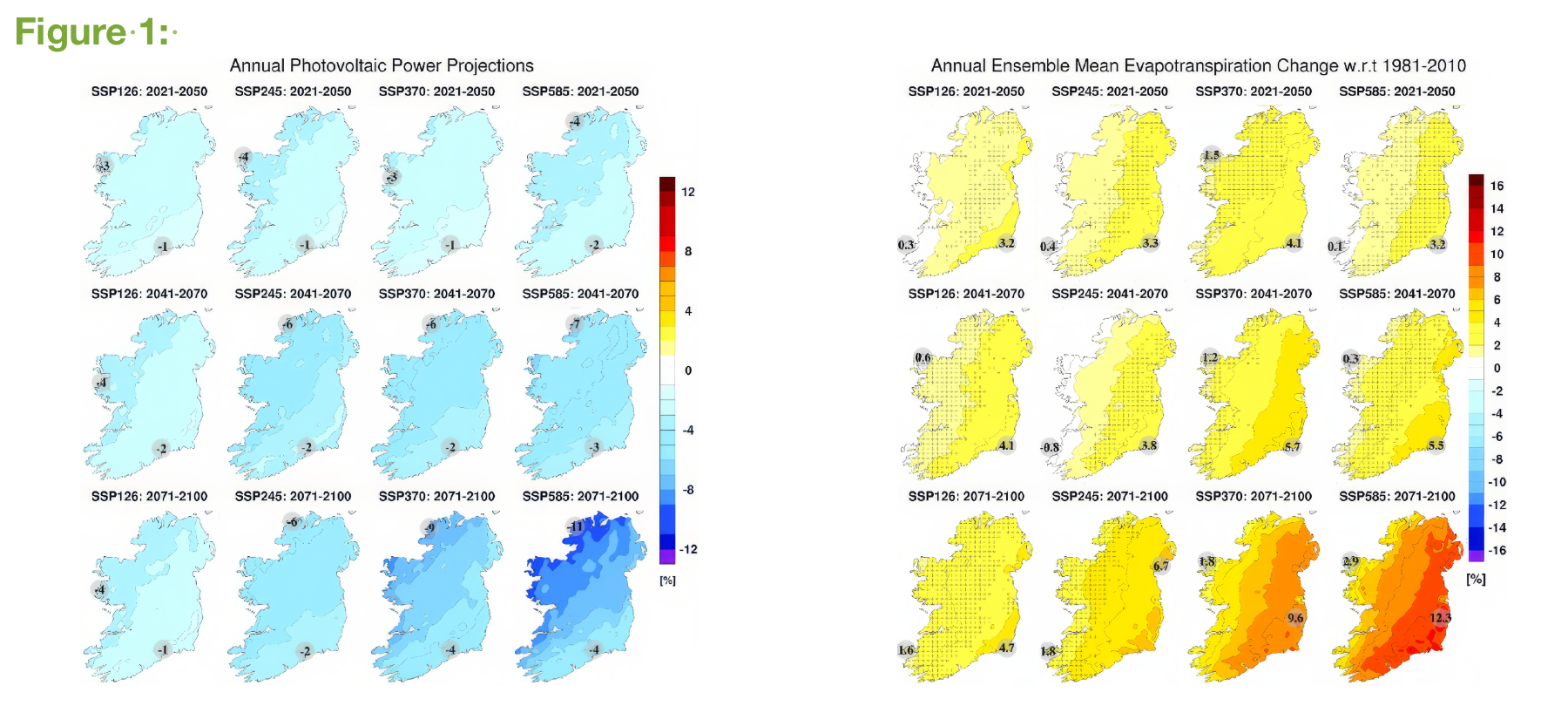
Figure 1. Projected changes (%) in mean annual (a) photovoltaic and (b) evapotranspiration. In each case, the future 30-year period is compared with the past period, 1981–2010. The numbers included on each plot are the minimum and maximum projected changes, displayed at their locations. (Credit: Paul Nolan)
Informing sustainable land use
Several projects in ICHEC are informing decisions on land use and sustainable transformation, including providing evidence for the National Land Use Review Phase 2 and for the implementation of the Nature Restoration Regulation.
The FORESIGHT project, funded by the Department of Climate, Energy and the Environment in partnership with colleagues in University of Galway, provides agriculture and land use modelling services to Ireland’s Climate Action Modelling Group. The EPA-funded project ALFIE project, led by Atlantic Technological University in partnership with ICHEC, examines land-use fragmentation with a view towards improving ecosystem connectivity.
The TREBUChEt project, also funded by the EPA and led by Dr Liam Heaphy, developed carbon cost estimations for the adaptive reuse of vacant or derelict buildings in Irish towns, as well as exploring the social and practical costs and barriers of returning vacant town buildings to use.
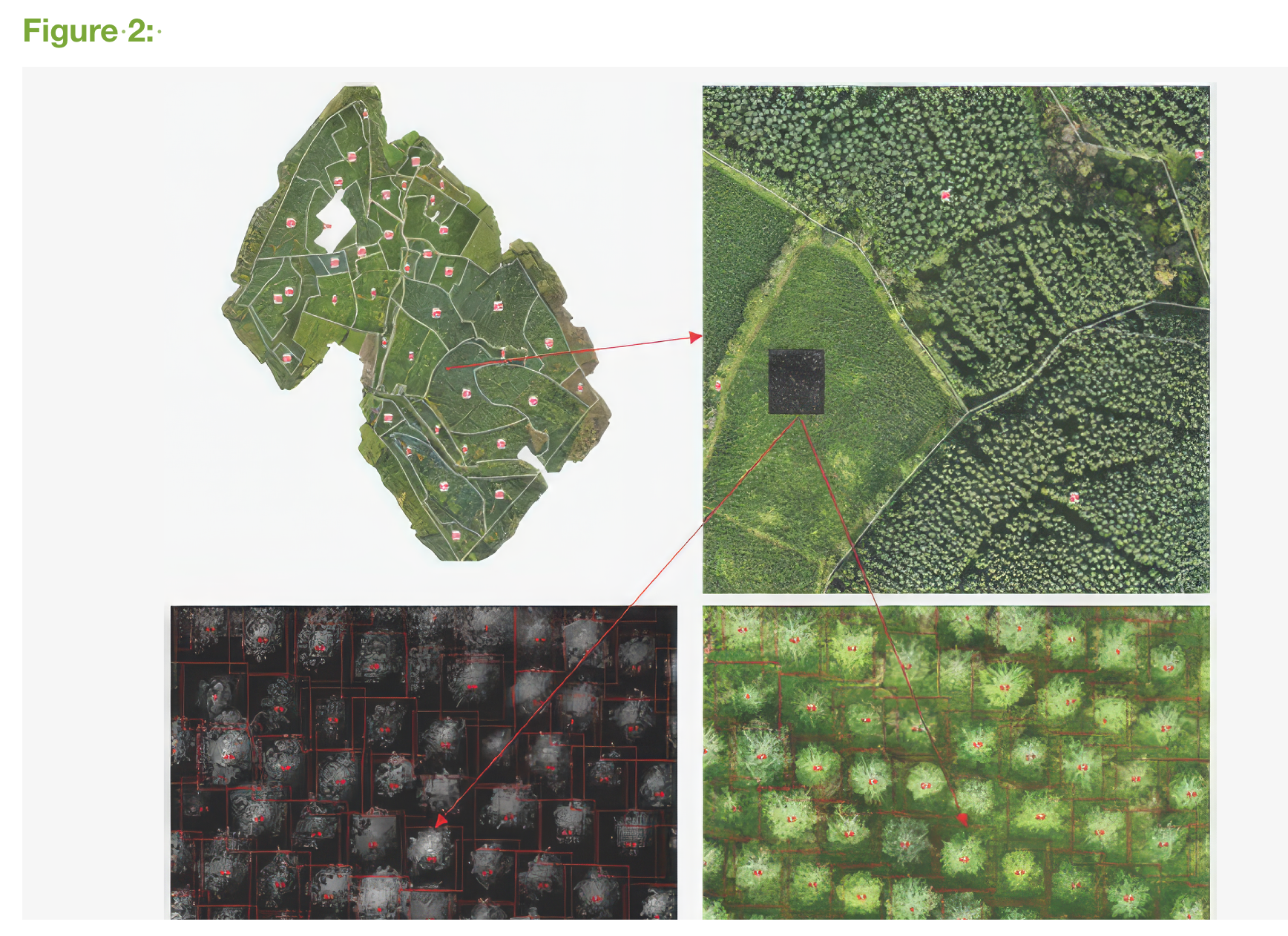
Figure 2. A method for tree detection using aerial images and a digital surface model. (Credit: Prakash Pilinja Subrahmanya)
Driving innovation to support transformative change
Achieving Ireland’s climate and sustainability ambitions will require more than policy and investment alone. It will depend on the ability of organisations to access and apply advanced digital technologies that can transform complex environmental data into actionable insights. Through its work with industry, ICHEC is helping to drive this transformation by enabling organisations to adopt innovative approaches based on high-performance computing, artificial intelligence, advanced analytics, and data science.
A key aspect of this work is supporting SMEs that are developing solutions to address environmental and sustainability challenges. By providing technical expertise and access to advanced computational capabilities, ICHEC helps organisations accelerate innovation while reducing the risks associated with adopting emerging technologies.
One recent project supported a marine planning and ecosystem restoration organisation seeking to improve the use of environmental data in coastal decision-making. The project involved the integration of biological, oceanographic, and spatial datasets into a consolidated Geographic Information System (GIS) environment aligned with Ireland’s marine planning framework. By transforming fragmented datasets into a coherent and reusable digital resource, the project created a stronger evidence base for marine spatial planning, environmental assessment, and future ecosystem restoration activities. This demonstrates how effective data management and digital tools can support more informed and sustainable decision-making.
A second project focused on the forestry sector, where an Irish SME sought to enhance its environmental monitoring capabilities through the application of artificial intelligence and computer vision (see Figure 2, in collaboration with Dr Prakash Pilinja Subrahmanya, ICHEC). Using drone imagery and ground-truth survey data, machine learning models were developed to automatically count trees, estimate tree height, and predict diameter at breast height (DBH), a key measure used in forestry management and carbon stock assessment. The resulting solution significantly improved efficiency and accuracy compared with traditional manual approaches. The project also evaluated the potential of satellite-derived data as an alternative data source, providing valuable insights into the strengths and limitations of different Earth observation technologies for commercial environmental applications.
Building on this work, ICHEC is currently exploring future opportunities to support the development of next-generation climate and environmental services. One such initiative involves investigating the use of satellite and aerial imagery combined with AI-driven analytics to detect illegal logging activity and monitor changes in forest canopy health over time. Such capabilities could provide forest managers, policymakers, and environmental agencies with near real-time insights, strengthening both environmental protection and sustainable resource management.
Together, these projects illustrate how digital innovation can help address complex sustainability challenges. By enabling organisations to harness advanced computing, AI, and data analytics, ICHEC is supporting the development of practical solutions that strengthen environmental stewardship, improve decision-making, and accelerate Ireland’s transition towards a more sustainable future.

Dr Liam James Heaphy
7th Floor, Tower Building
Technology & Enterprise Campus
Grand Canal Quay, Dublin 2
D02 HP83, Ireland.
liam.heaphy@ichec.ie
www.ichec.ie/staff/liam-heaphy
 Ossian Smyth TD
 Florika Fink-Hooijer
 Antoine Oger
 Laura Curtis-Moss
 Anthony Costello
 Niall Ó Donnchú
 Mike Savage
 Brian Carroll
 Oisín Coghlan
 Stephen Onakuse
 Kevin O’Sullivan
 Hendrik W van der Kamp
 Philip Nugent
 Adrian Smyth
 Ainhoa Gonzalez Del Campo
 Geoff Doole
 Clare Pillman
 David Greenfield
 Danielle Conaghan
 Peter McEvoy
 Triona McGrath
 J Owen Lewis
 Gavin Smith
 Imelda Hurley
 Lucy Gaffney
 Dr Venkatesh Kannan
 Kevin Hegarty
 Eimear Cotter
 Aditya Arora
 Patric Child
 Eleanor Roche
 Andy Bleasdale
 Andrew Muir MLA
 Chris Hewitt
 Francesca Racioppi
 Danielle Conaghan
 Christopher Hammond
 Laura Díaz Anadón
 Lorna McAdoo
 Conor Murphy
 Mark Horton
 Niall McLoughlin
 Susan Hegarty
 Zoe Kavanagh
 Niall Ó Donnchú
 Venkatesh Kannan
 David McGee
 Anna Rose
 Paul Hogan













 Levent Ergin
 Veronica Manfredi
 Francis Finnerty
  Timmy Dooley TD
  Julie Thompson
  Mark Thuillier
  Martin Hutchings
  Mark Nolan
  Ian Marnane
 Tom Pickerell
 Caroline Kuzemko
 Alex White
 Dr Lizzy Pinkerton
  Dr. Lisa McNamee
  Denise Cahill
 Claragh Mulhern
 Sophie Reynolds
 Eva Maria Bille
  Jacinta Conway
  Joe Duignan
 Maria Fitzpatrick
 Martina Hennessy
  Noel Meehan
 Enda Murphy
  Barry O’Loughlin
 Paul O’Neill
 Irene Rondini
  Jessika Roswall
 Fiona Simpson
 Anne Goggin
  Catherine Vilquin
  Conall Boland
 Colin O’Hehir
 Janet Lynch
 Sara Lynch
 Maria Kelly
 Deborah Spence
 Juan Pablo Martinez
 Valentina Tarasco